Tuesday, December 3, 2013

The RC&D GeoLab: a Jump-Start for the RC&D Social Revolution - Repost

The RC&D GeoLab: a Jump-Start for the RC&D Social Revolution

A warm welcome to the RC&D GeoLab

A Jump-Start for the RC&D Social Revolution

Friends and Colleagues in RC&D,
Not too long ago, RC&D councils across the nation looked very different than they do today.
The things we did were imbued with a spirit of excitement, a palpable energy: in our communities, we were the catalysts and the initiators. We were the first ones people looked to for solutions. We were a force.
But the world has changed a lot since then. And so have we.
Yes, our dream is the same as it once was: to sustain our natural resources and create resilient communities. But our spirit isn’t.
Let’s be honest: we’ve taken a beating. Budget elimination. Dissolving partnerships. Eroding participation. Growing frustration. We’re losing our sense of purpose and possibility.
And so here we are today. What have we become? Instead of living up to our roles as catalysts and change-agents, today — at best, if we have staff — we’re mired in the vicious cycle of chasing grants just to survive and pay the rent.
This is not who we were meant to be. And frankly, it’s not who our communities need us to be right now.
If we’re going to live up to our dream, we’re going to need to change — quickly. And we’re going to have to be brave — very.
At the New England RC&D Fall Conference on September 26, 2013, we unveiled the powerful new GeoLab concept — an idea that could change how we work forever.
Soon we intend to offer GeoLab to all RC&D Councils across the country. But today we’re giving you a sneak peek into the RC&D GeoLab — so keep on reading!

Introducing the RC&D GeoLab:

What is the RC&D GeoLab?

RC&D GeoLab is a social enterprise sponsored by the North Country RC&D in New Hampshire. As a social enterprise, the GeoLab aims to improve human and environmental well-being. However, first and foremost,the GeoLab is  a for-profit business with a special focus: ensuring hard earned profits go back to the cause instead of stockholders!
GeoLab is a virtual business incubator and powerful launchpad for new projects in your community—- projects designed to protect,  preserve, and celebrate your area’s unique sense of place.
Inspired by National Geographic’s Geotourism Charter, GeoLab’s mission is to support initiatives that enhance your community’s unique geographical character. This focus on geotourism expands and enriches our original commitment to natural resource conservation, community development, environmental protection, and cultural and historical preservation.
One important benefit of GeoLab is that it can provide a sustainable revenue stream for your RC&D. No more groveling for funds. No more wondering if you’ll survive.
No more struggling to do what you were always meant to do: be a catalyst.
But even more exciting is what GeoLab means for your community. It means that new projects no longer have to flounder, struggling to scrape together both funding and support. GeoLab gives new initiatives a lifeline in the early stages, when they’re at their most vulnerable — and it rallies an entire community of supporters behind their success!
Projects incubated by GeoLab will benefit from a well-planned marketing program, fundraising support via crowdfunding, and collaborative online project communities on the GeoLab platform — with more robust professional support planned for the future.

What makes the GeoLab unique?

GeoLab’s DNA is built on three powerful emerging concepts. You may or may not have encountered them before, and we’ll be explaining them in our webinars. For now, here is a brief introduction:
  • GeoLab is a virtual business incubator. Business incubators are a fairly recent phenomenon, and they exist to help new projects succeed. Virtual (online) incubators are an even newer concept. Whether they exist in the bricks-and-mortar world or online, incubators like GeoLab are vital to a new project’s success. Consider this: in the US, fewer than half of new ventures survive past their fifth year — but incubation brings the survival rate up to 87%!
  • GeoLab supports geotourism projects. Geotourism is an emerging concept introduced by the National Geographic Center for Sustainable Destinations. It is remarkably in line with what we as RC&Ds do already, as it focuses on projects that respect and enhance an area’s natural resources, cultural and historical heritage, and community wellbeing. It’s a fresh way to frame what we’ve been doing all along!
  • GeoLab harnesses crowd power to promote, fund, and launch projects. “Crowd technology” is the way of the future. Harnessing the power of the internet, it allows many people to pool their money, resources, and ideas in order to create an impact on a massive scale. You may have already seen crowd power in action on crowdfunding sites like Indiegogo and Kickstarter.

Why the GeoLab?

The GeoLab concept was forged from a perfect blend of frustration and imagination.
We know that we live in a new world with new needs — and it’s clear that we must radically rethink how we serve that world. We sense that our impact could be bigger and that our vision could be braver.
That’s why we’re bringing you GeoLab: because it can radically transform our impact, making it possible for us to do more of the things that matter most.
And just as importantly: because it gives us a second chance at that big dream of ours.
The world has changed in the last 51 years since RC&D started. It’s time to catch up.
What’s Next?
Soon you’ll have the opportunity to learn more about GeoLab and its potential. We’ll cover:
  • How GeoLab works
  • What makes GeoLab unique — from crowdpower to geotourism
  • GeoLab’s market & profit potential
  • How to bring GeoLab to your community
We’ll also be inviting you to become a GeoLab Charter Member, which not only helps us launch this project but puts you on the fast track to running your own GeoLab within your community!
Additionally, we have created a private RC&D GeoLab LinkedIn Group that you are invited to join to discuss the GeoLab further among colleagues. To join: login to Linkedin, search for ‘RC&D GeoLab’ and hit Join.. This group will allow us to keep in contact as our RC&D GeoLab develops and until the GeoLab website is operational.
Finally, we are proposing that national Online Forums to present and discuss the RC&D GeoLab be organized in early December so that this opportunity can be extended to all RC&D Councils around the country, even those that may have already closed or are planning to close. Stay tuned for the announcement of the dates.

JOIN US FOR THE REVOLUTION

Rick DeMark, Executive Director, North Country RC&D, NH
John Chilton, Mulga Mail Group, Alton Bay, NH
P.S. Our thanks to the members of the New England Regional RC&D Association who joined us during their recent Conference for our first ‘Offline RC&D GeoLab Forum’. I hope they enjoyed participating in it as much as we did. It was the questions they raised during the Forum that inspired us to establish the Library!
Hope you’ll find answers sought within the Library – if not check out our ‘Get in Touch’ – put your question to us and be sure you check for a reply by joining us in our private RC&D GeoLab LinkedIn Group. See you there
Cheers
John, ‘Chief Clicker’ ;-)

GeoLab Is a Virtual Business Incubator - REPOST

http://www.lakegeolab.org/115/what-is-business-incubation/

GeoLab Is a Virtual Business Incubator

 Business incubators are a fairly recent phenomenon, and they exist to help new projects succeed. Virtual (online) incubators are an even newer concept. Whether they exist in the bricks-and-mortar world or online, incubators like GeoLab are vital to a new project’s success. Consider this: in the US, fewer than half of new ventures survive past their fifth year — but incubation brings the survival rate up to 87%!

What is Business Incubation?

Business incubation is a business support process that accelerates the successful development of start-up and fledgling companies (and projects) by providing entrepreneurs with an array of targeted resources and services.
These services are usually developed or orchestrated by incubator management and offered both in the business incubator and through its network of contacts.
A business incubator’s main goal is to produce successful firms that will leave the program financially viable and freestanding. These incubator graduates have the potential to create jobs, revitalize neighborhoods, commercialize new technologies, and strengthen local and national economies.
Critical to the definition of an incubator is the provision of management guidance, technical assistance and consulting tailored to young growing companies.
Incubators usually also provide clients access to appropriate rental space and flexible leases, shared basic business services and equipment, technology support services and assistance in obtaining the financing necessary for company growth.
Incubators vary in the way they deliver their services, in their organizational structure and in the types of clients they serve.
Highly adaptable, incubators have differing goals, including diversifying rural economies, providing employment for and increasing wealth of depressed inner cities, and transferring technology from universities and major corporations. Incubator clients are at the forefront of developing new and innovative technologies – creating products and services that improve the quality of our lives in communities around the world.
The earliest incubation programs focused on a variety of technology companies or on a combination of light industrial, technology and service firms – today referred to as mixed-use incubators.
However, in more recent years, new incubators have emerged targeting industries such as food processing, medical technologies, space and ceramics technologies, arts and crafts, and software development. Incubator sponsors have also targeted programs to support microenterprise creation, the needs of women and minorities, environmental endeavors and telecommunications.
Source: The National Business Incubation Association

Friday, August 23, 2013

Downtown Revitalization in Small Town America is Important

Repost From May

Enjoy, Jeremy Shaffer


Friday, May 31, 2013


Downtown Revitalization in Small Town America is Important


A Beginners Look at Economic Development  

Downtown Revitalization is important, however small communities are at a disadvantage. Small towns and small cities would love to have multiple employers, and thriving retail areas on Main Street. Though often times it is hard to find the proper tools, and know how to put together a successful approach. Building the foundation for small town success is hard and complicated and takes multi faceted planning. This includes a broad Master Comprehensive planning, Financial Planning/Stability, and Service Delivery Need/Analysis for starters.Then Marketing, Public Relations, Economic Development, Community Development and a myriad of other more community specific studies need to be addressed and action plans initiated.
The information over a vast number of professions and skill sets must be put together into one dynamic force and must be implemented over time.

Recently, I was explaining a DART ( Downtown Assessment Resource Team) visit and discussing my experience looking into becoming a Main Street Community. After that discussion I went in search, as many times before, to find a small toolbox filled with the information that may help, without expending the Capital and resources on a DART visit to better understand the Downtown Revitalization approach. Much of what I have experienced has been intriguing when it comes to Economic Development, however I have learned much of the information is over rated and over sold. The Main Street Program is a great endeavor and ultimate goal, though there is a foundation that must be put in place in order to achieve such success and be recognized. I believe that with the right amount of planning and action a small community can become vibrant and successful. The identification and award for the achievement through recognition will take back seat when done properly, because the success will be a happy stable community.

Now for the Holy Grail of information. I have searched and been part of many discussion regarding understanding the needs of the community and businesses. Much was underlined by preconceived notions, outdated information, and special interest groups. None of this being bad, just not what needed to be developed in order to receive quality information that would assist in putting together a measurable action plan. Recently I stumbled across a Tool Box to assist in doing what many had been talking about. I was so excited I copied the introduction and linked the information to share with my locals. It was put together in 2010 by a collaboration of University Extension Agencies - MN, OH, and WI. This will help get your planning and information gathering underway. Next stop will be funding, however that is a topic in itself.
I hope this helps. HERE IS YOUR TOOL BOX

Jeremy Shaffer, Highland County Commissioner


Introduction - Downtown & Business District Market Analysis
For the last four decades, small cities (population of less than 100,000) all across our country have seen continued economic leakage from downtown to outlying edge locations. Once the center for community and economic activity, downtowns have suffered the loss of retail and other businesses to sites in shopping centers and commercial strips. Downtowns continue to suffer economic hardship brought on by fierce retail competition from category killers, large discount stores, and regional shopping centers. Many small city downtowns face high vacancy rates and a poor mix of retail tenants. They typically lack the market research support available to the big retailers and shopping center developers.
Market studies are typically conducted in downtown districts for a number of reasons. Examples include:
This market analysis toolbox is designed to help local business leaders, entrepreneurs, developers, and economic development professionals across the country understand the changing marketplace and identify business and real estate development opportunities that are realistic and make sense for their communities. It will introduce and guide the user through many of the techniques used in analyzing specific development opportunities for a downtown area. The toolbox is intended to be a self-help resource that can be used in a locally-initiated market analysis.
However, downtown market analysis today should differ from retail and shopping center market analysis. Instead of focusing strictly on retail, new emphasis is placed on the particular strength of downtown, its assets, history and quirkiness. Traditional retail is part of the equation, but only part of it. Some of the new additions to this toolbox build on factors that are unique to downtown – things that tell a compelling story about the advantages of doing business downtown.
The 2011 update of the Downtown and Business District Market Analysis toolbox is a result of a collaborative effort involving University of Minnesota Extension, Ohio State University Extension, and University of Wisconsin-Extension. The revised toolbox (building from the original University of Wisconsin-Extension toolbox) incorporates new tools developed in the partnering states. The update was supported with funding from the North Central Regional Center for Rural Development. The toolbox is based on and supportive of the economic restructuring principles of the National Trust Main Street Center. The Wisconsin Main Street Program (Wisconsin Department of Commerce) has been an instrumental partner in the development of this toolbox.

Brought toYou By
University of Wisconsin-Extension - CCED
The Ohio State University Extension 
University Of Minnesota Extension 

What is Small Town USA?

http://politicslikebackyardchickens.blogspot.com/2013/06/what-is-small-town-usa.html

Reblog From June.

I have been very busy, and have many posts started, however it has been hard to finish with so many things going on at the end of summer. My oldest started Kindergarten, among a myriad of other things. Check this out and my other posts. I hope my posts and reposts help you on your journey to rebuild America.

Jeremy

Monday, June 3, 2013


What is Small Town USA?


Dear Future Resident,

I have served in public service for more than a decade, being elected to my first position shortly after High School. I have had a passion for community service and the rural way of life. I want to assist rural communities in creating a better quality of life for residents without losing identity and appeal. With economic decline, and population shifts across America, small towns have been among the biggest losers. I hope to see small town life be embraced once again and an adaptive planning that takes advantage of technology leads to a small town renaissance.

I have been on a search for years to find what makes Small Town USA so special. I have come up with my own list of unique things I personally love. Though time and time again I have found it hard to zero in on the essence and quantify it. When small town USA can be captured by objectives of good and not so good, then it can be recreated in all its glory. It will take planning and hard work to bring this rebirth about. It will take innovation and spirit to realize the new community that everyone will yearn to call home. On my quest I have came across a website Small Town Gems. This site and the people behind it have done a superior job to sum up what is unique and desirable about a small town. They didn't stop there; they also put into play what is less desirable about small towns that have lost their charm. They even throw out spoilers to watch for that give false impressions. I find this particularly amusing; due to the fact Main Street Program/Endorsed Communities weren't at the top of their list. (Inside Smile)

The honest and common sense approach to from this site really brought to perspective to what I have believed for years, and in fact it gave me a few missing pieces to my search to finally quantify the perfect small town. Now add a little innovation and a lovely balanced community plan may emerge. Check out what Small Town Gems has to say below, and visit their website. From what I see, I would take their advice on your next weekend trip around the Country. They really love towns, and have put a tremendous amount of thought and work into a passion.

Welcome Back to Small Town USA

Jeremy Shaffer, Highland County Commissioner

The Information Below is from Small Town Gems 2013 - The Holy Grail of Small Town Information
WHAT IS A 'SMALL' TOWN?
What metric do we use to classify these towns as ‘small’?  Most of the towns on our site have a population of 10,000 or less.  In most cases, we do not consider a town to be a 'small' one if it has a population in excess of 15,000 full-time residents. Exceptions are places like Savannah, Georgia and Albuquerque, New Mexico.  Technically, these are large metropolitan areas, but contain neighborhood historic districts or other clusters of buildings reminiscent of small towns.  Old Town Albuquerque is an example of this.  Many of the small towns on our web site have a population of two to three thousand year-round residents.

WHAT IS A 'DESIRABLE' SMALL TOWN?
How do we describe the ambiance or personality of the towns on this web site?  The adjectives historic, small, quaint, charming, romantic come to mind.  Or we could employ the phrases “a step back in time”, “picture postcard” or “small town Americana at its best”.  Many have historic districts, attractive store fronts on Main Street, antique shops, art stores or other boutiques, Victorian homes, bed and breakfast lodging.  Because of their distinctive quality, numerous towns on our web site have been Hollywood film locations. 
As you enter these towns, they should pass the following emotional tests:

1. Does this town remind you of a Currier and Ives print?2. Do you think to yourself “I can’t wait to tell my friends about this place”?
3. Do you wonder if there is enough capacity in your camera?
4. Is this place similar to the town where your grandmother was raised?
5. Could this be the great retirement location you've been searching for?
6. Wouldn't this be a safe, wholesome place to raise children?


The following criteria are used to earn our approval:
  • Distinctive Architecture
  • Part of the downtown has been designated a state or national historic district
  • Numerous commercial and residential properties recognized by the National Register of Historic Places
  • An abundance of stone or brick buildings in downtown
  • Pedestrian/bicyclist friendly. Wide sidewalks with frequently-spaced shaded benches
  • Bike or walking path
  • County seat with historic courthouse
  • Visitors Center
  • Lampposts along the main thoroughfare
  • Large fountains in green spaces
  • Luxurious tree and flower landscaping
  • Art galleries, antique stores, and specialty boutiques
  • College or university in or near the town
  • Bed-and-breakfast lodging, usually in Victorian or Bungalow-style housing
  • Gourmet coffee shops and bakery
  • Ice cream parlor and confectionery shops
  • Drug store with vintage soda counter
  • Historic opera house offering live performances
  • Free summertime concerts in the park
  • Clock towers with chimes
  • Brick/cobblestone sidewalks or streets
  • A river or canal flows through the downtown
  • Proximate to a lake or ocean
  • Clean, easily accessible public restrooms
  • Wooden picket or wrought iron fences
  • Wrought iron railings on upper-story balconies
  • Unusual scenery nearby
  • Vintage train station with antique locomotive,caboose and passenger cars offering excursion rides.
  • Iron or covered bridges
  • Tourist trolley buses and horse-drawn carriages
  • Abundant and decorative trash receptacles
  • Kiosks containing downtown map and directory
  • Historic markers along downtown streets
  • Old service station with antique vehicles   


  • WHAT ARE THE 'BEST' SMALL TOWNS?
    There are several good books that use the phrase 'best small towns' in their titles, including The 100 Best Small Towns in America,  The 50 Best Small Southern Towns and The 100 Best Small Art Towns in America.  The 'best' small town is in the eyes of the beholder, just as the 'best' dessert is in the taste buds of the beholder.   Although we have provided viewers with some criteria we use to quantify the adjectives best and nicest, our assessment is otherwise subjective.   That is why we provide an extensive number of photos of our recommended small towns so the viewing public can 'best' be the judge.


    WHY DO WE RECOMMEND THESE TOWNS?
    ... you are investigating small towns for retirement or relocation, it would be prudent to consult demographics such as crime rate, per capita income, rate of unemployment, average resale home prices, or the percentage of the population that are college graduates.  Our recommendations for best or nicest are not based on these statistics.  Our recommendations are based on what we consider to be the best small towns for weekend getaways, the best places for temporary relaxation, the best small towns for a romantic interlude, or simply to satisfy your wanderlust. We are, after all, primarily a tourism, entertainment and travel website. Instead of sociological statistics, our recommendations of small towns are based on the five physical senses (what you can see, smell, hear, taste and touch), a sense of nostalgia and romance, a sense of security (it feels safe to wander about), a sense of curiosity (the desire to explore), and the most intangible, a sense of home.   In these modern times, many of us feel victimized by the thrust into an ever-faster world of high-stress, technologically-demanding existence.  As a source of relief from these pressures, it is only natural that we would benefit from a brief escape to a simpler, quieter, slower environment, reminiscent of yesteryear.  Hopefully, visits to these small, quaint, charming, nostalgic towns will provide a respite from your day-to-day hectic routines.

    WHY DO WE DISQUALIFY CERTAIN TOWNS?

    When we visit a town, and find that it is not of sufficient quality to merit our Approved List, it is recorded in our Disqualified List.  Some of the reasons for a disqualification are as follows.
    1. The town is too small to offer enough amenities such as dining, shopping or lodging.
    2. The town has tourism potential, but is currently in the process of renovation, often after decades of neglect.
    3. The town does not appear to be safe enough for pedestrian visitors.
    4. While the town may have some redeeming features, its location is so remote that we cannot recommend our viewers expend the effort to reach it.  Exceptions to this are towns such as Eureka Springs AR, Telluride, CO, and Galena, IL.  They are significantly ‘off the beaten path’, but well worth the extra miles.  On the contrary, if a small town has minimal entertainment amenities, we may still recommend it because it is easily accessible from an interstate highway. Paxico, KS is a good example. Paxico is a cute town, although it has only a few antique stores as entertainment for visitors. But it is conveniently located just 2 miles off Interstate 70. If the town were not so accessible, we would not recommend it.
    Thousands of small towns in this country advertise their downtown areas as ‘historic’.  The difference between ‘historic’ and ‘historic district’ can be as severe as the distinction between ‘rap’ and ‘rhapsody’.  The term ‘historic’ should be used to designate structures of ‘historical significance’.  Unfortunately, in many towns, ‘historic’ simply means ‘old’.  And all too often, ‘historic’ is used to describe buildings that are dilapidated, or in such a state of disrepair from terminal neglect, they should be bulldozed.  An ‘old’ outhouse is still just a toilet, even if George Washington did shit there.  Unless a municipality displays an official federal or state historic district emblem (white letters on chocolate brown background), ignore the ‘historic’ baloney.
    Beware of ‘Main Street’ Towns
    Hundreds of small towns in this country proudly display signs proclaiming themselves to be a 'Main Street Community'. These municipalities are recipients of grants from their state governments. The purpose of this funding is to attempt to revitalize their historic downtowns and neighborhood commercial districts, often after decades of neglect. In our travel experiences, most ‘Main Street’ small towns are undesirable from the tourist perspective, because their infrastructure and economies are too deteriorated to be resuscitated.The following are symptoms of an undesirable small town.  To paraphrase Jeff Foxworthy, “You might be in Redneckville if. . . ."

    Disqualify if...


  • The hottest selling item at the local convenience store is fried pork rinds - and it comes in five flavors
  • Tourists are graciously welcomed with NO PUBLIC RESTROOM and OUT OF ORDER signs
  • BAIL BOND signs appear on the courthouse square
  • Both the MEN's and WOMEN's restrooms have condom dispensers, with instructions for proper usage
  • The name of the local bookstore starts with XXX or ADULT
  • The largest directional sign on the highway into town reads SANITARY LANDFILL
  • The mayor's first name is Bubba, and his last name is an alias.
  • The sign next to the stoplight says WAIT FOR GREEN
  • Predominance of MONEY ORDERS SOLD HERE signs
  • PAWN SHOP and CHECK CASH - PAYDAY ADVANCE businesses
  • The largest employers in town are the hospital and jail
  • TAXIDERMY and DISCOUNT TOBACCO stores
  • Residences and businesses with bars on all the windows
  • Chained dogs
  • NO LOITERING and SPITTING PROHIBITED signs
  • Plywood windows
  • The one restaurant in town warns that shirt and shoes are required
  • I once saw a sign in Pennsylvania advertising FRESH COAL. If the 'fresh' coat of paint on the small town WELCOME sign was applied in the previous century, you may have just entered Toilettown, U.S.A.


  • RELOCATION SUGGESTIONS

    Our primary goal is to educate our viewers concerning the quality of the small towns we visit.  Many of our patrons use this information when planning vacations or weekend getaways. But some use our web site to investigate the possibility of small town retirement or relocation. We like to think of ourselves as a travel entertainment source. We do so by offering our opinion and providing photographs and other information about small towns.  Some viewers have pointed out (and rightly so) that while our visual evidence is helpful in assessing the quality of towns, such information certainly does not constitute a complete quality assessment of these locales.   In an attempt to respond to these comments, we have formulated the following general suggestions listed below.
    1. Be skeptical about information provided by the Chamber of Commerce or realtor concerning a small town in which they have a vested interest.
    2. A good source of honest information about a town can be found by subscribing to a website forum concerning the geographic area of interest.  This is why we provide a forum at SmallTownGems. Pose a question to the forum members - such as "I am anticipating a move to East Podunkville.  What it's like to live there?" There is no substitute for the experience and opinion of someone who has lived in these small towns.
    3. Telephone or (better yet) visit the Humane Society or SPCA in the county of interest.  If these organizations do not exist, this could be a 'red flag'.  Ask them about the general animal situation in the county and the existence of local laws to protect animals from cruelty (not animal control laws – those protect human beings from animals).  As Mahatma Gandhi said, "The greatness of a nation and its moral progress can be judged by the way its animals are treated".  This is also applicable at the local level.
    4. Talk to a public official about zoning ordinances.  There is usually a correlation between strictness of zoning regulations and quality of residents. 
    5. Consult demographics from the U.S. Census Bureau.
    6. In rural areas, consult with local well drillers and the Agricultural Extension Agent before you buy/build. Most have resided in the area their entire lives and know the topography, soil and water conditions like the 'back of their hands'.
    7. Speak to the Sheriff's Department or Police department about law enforcement problems in the community.
    8. Visit the area of interest during its worst weather season - Minnesota in December, Florida in July, Seattle during the rainy season and Santa Fe in its windy season.
    9. Talk to people at a local bicycle shop or walking/running club.  My experience is that they are usually well-educated/affluent members of the community.
    10. In a sparsely populated area, unless a small town is a county seat, its long-term economic viability is questionable.
    11. Subscribe to the local newspaper well in advance of a relocation.
    12. The existence of a health food store is often indicative of a high-quality community.
    13. On average, small towns with a college are of higher quality than those without an institution of higher learning

    14. In the opinion of Forbes magazine, reliable indicators of the quality of a community include:

      a) percentage of homes that are occupied by their owners (and not rental property tenants)
      b) incidence of crime
      c) percentage of the population that graduated from college
      d) charitably-inclined residents. To find out which locales are the most giving, access the website Chronicle of Philanthropy.

      According to Smithsonian magazine, a high quality small town can be quantified based on the following:
      a) Museums
      b) Historic sites
      c) Botanic gardens
      d) Resident orchestras
      e) Art galleries
    The Above Information is From Small Town Gems Website

    Friday, August 9, 2013

    One downtown building gives life to many new retail stores

    One downtown building gives life to many new retail stores

    Guest post by Cathy Lloyd, The Village
    In the summer of 2007, I had an idea to help the state of retail on the square in downtown Washington, Iowa. Since Wal-Mart came to town in the ‘70s, there had been a steady decline in the number of retail businesses in the downtown area. I hoped by making shopping an “experience” we could keep some Washington people in town instead of defecting to Iowa City….but I knew it would have to be really unique.
    A large historic two-story building on the square was in the process of being renovated. I talked to the owner about my idea to have a retail complex on the first floor. I would call it “The Village”, and it would consist of small boutique-type shops surrounding a central courtyard. The shops would be designed with wood façade fronts to replicate a turn-of-the century Iowa village. Clapboard siding, awnings and window boxes would be features, and each shop front would be different. I would rent the main area from the building’s owner, divide it into small shops at my own expense, and those shop “owners” would pay me rent.
    In addition, the courtyard would feature vendor carts, and a comfortable sitting area (our “gentlemen’s area”, we call it!) Complimentary coffee—or in the summer, lemonade— would be available. The rent for the vendor carts would be on a month-to-month basis, and would give timid souls the opportunity to “get their feet wet” in retail before moving into a shop. Thus The Village would act as a true incubator: vendor cart users might move into shops, and shop owners might move on to their own stand-alone shops.
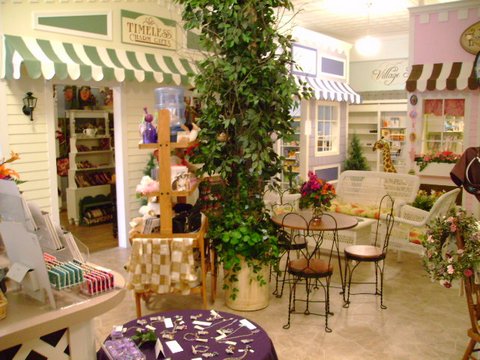
    The Village inside tables - Washington Iowa - Photo by Cathy Lloyd
    The Village courtyard between the stores includes comfortable places to sit, called the “gentlemen’s area.” Photo by Cathy Lloyd.
    A central checkout area would enable shoppers to wander from store to store with their shopping basket without having to pay for their purchases in each shop. Shop owners would not need individual counters and employees in their shop, allowing for the maximization of space.
    I knew I wanted to concentrate on retail…not beauty shops, insurance, consignment shops or tattoo parlors! Some ideas for shops I originally envisioned:
    • Year–Round Xmas Shop
    • Books and Stationery Shop
    • Women’s Specialty Shop
    • Quilt Shop
    • Antique Shop
    • Tea Room
    Each shop would be decorated and furnished by the renter. All shops would be expected to maintain the same store hours, and participate in any sales or promotions. The shops would be, by design, small. My goal was to attract those who always had a dream of owning their own shop, but didn’t have the funds necessary to purchase a building or pay high rent. The small size of each shop would only require a small investment in inventory…and if the worst happened and the shop had to close, at least it hadn’t depleted one’s life savings, and shop owners would have the satisfaction of knowing that they at least tried something they always wanted to do.
    Once I got the go-ahead from the building’s owner, I set to work designing the complex—I wanted to stay true to the 1890s architecture of Washington— and I wanted to maximize every inch of space. No one could quite envision what I had in mind, and those who could told me the space was too small. They didn’t know what I was going to do with a pole right smack in the middle of the store (it became a tree!), and my banker asked my husband if I was “crazy”!!!
    The Village column tree and a vendor cart - Washington Iowa - Photo by Cathy Lloyd
    The column that turned into a tree, and right next to it, one of the vendor carts that gives hopeful retailers an inexpensive way to get started. Photo by Cathy Lloyd.
    We began construction in the fall of 2007, and moved into The Village in July of 2008…the day they poured concrete for the sidewalk in front of our store! Since the downtown area was such a mess, we weren’t able to have a Grand Opening until the next summer! But that didn’t stop the customers from coming!
    I was fortunate to find five varied and unique shops to fill the Village at the beginning. The current residents of The Village are:
    • “Girlfriends” gifts for girls of all ages;
    • “Petticoat Ranch” a touch of the Old West;
    • “Village Kids” a spot for tots;
    • “The Soaring Sparrow” gourmet coffees, teas and linens
    • “Creations by Char” unique, handpainted clothing and accessories
    • “Plethora” featuring shabby chic handpainted furniture and accessories
    The vendor carts are always rented, with a nice variety of merchandise.
    The Village shop - Washington Iowa - Photo by Cathy Lloyd
    A typical shop in The Village. Photo by Cathy Lloyd.
    The Village shops range from 80 to 144 square feet, with most being 120 sq ft. The rent is based on square footage, and includes all utilities, liability insurance, some expenses such as packaging, fees and dues, minimal advertising, as well as the additional “common space” in the courtyard and the display windows. In addition, there is a “gallery wall”, where local artists can display their work for a small commission fee.
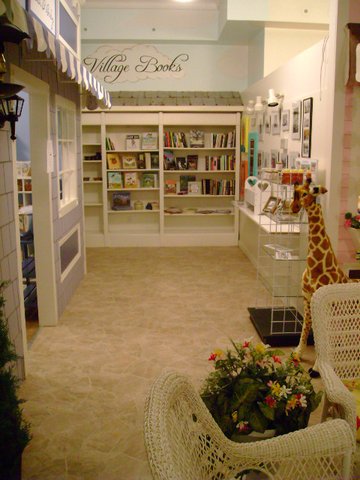
    Inside courtyard
    You can see how each shop in The Village has its own front. The gallery wall gives local artists an affordable place to put their art on sale. Photo by Cathy Lloyd.
    All shop owners take turns working at the central check out counter, the hours they work are based on the square footage of their shops(s). This eliminates the further expense of hiring part time help.
    The recession years haven’t been the best climate for retail, but we are persevering. The economy took a nose dive, and suddenly no one had any money. We were counting on attracting customers from Iowa City and Cedar Rapids, but then came the floods, and those poor souls had to use their shopping money to rebuild their homes. The higher gas prices actually worked in our favor, as those spur of the moment trips to the mall became less frequent. Then there was the street construction, a bitter cold and icy winter, and a mini-tornado! The plagues of Egypt had nothing on us! We began to think we were jinxed.
    But compliments from the townspeople keep us going; and daily we hear things like “This is so neat!”; “It looks like Galena in here!”; from a group of Iowa City women: “To heck with the Amanas…we’re coming here from now on!”, and “I live in St. Louis, and I can’t find some of these things there!”.
    I truly believe that this is the future of retail in small communities, and we plan to be here for a long time!

    Thursday, July 18, 2013

    Pervious Concrete Pavement


    Pervious Pavement - The Perfect Material for Sustainable Streets and Walkways.

    When I was Mayor, I heard about a project at the Cincinnati Zoo using pervious pavement for walkways and drives. After a couple years in use the Cincinnati Zoo has great things to say about pervious pavement. The product has excellent life span, better than blacktop and is concrete based. The material itself has a built in fix for water displacement, which is the number one maintenance issue in all types of streets and walkways. Check out the link to pervious pavement. It is a foundational piece for a sustainable infrastructure.

    Jeremy Shaffer, Highland County Commissioner

    Pervious Pavement

    Cincinnati Zoo - Green Initiative

    StormWater Management & Permeable Pavement - University of Kentucky

    Friday, July 12, 2013

    Steal this small town development idea

    Steal this small town development idea
    Rebates to City Service for Core Development of Key areas.

    A few weeks ago I posted on Economic Development incentives, focused on available options in Ohio. The link, Steal this small town development idea, offers an interesting local model for residential building/development incentives in targeted areas of Burnet, TX. The incentive program hopes to reduce urban or rural sprawl.

    Another Good Idea

    Jeremy Shaffer, Highland County Commissioner

    Thursday, July 11, 2013

    How to Market A Community - Great Article for Starters

    This a great repost from a blog I actively follow. It covers the do's or dont's and is an informative, perfect if your starting from scratch or freshening an active plan. Some of the items it seems many of us are drawn to do, and they are beginner mistakes. I hope you find this article helpful in establishing or re-establishing your rural community image.
    Jeremy Shaffer, Highland County Commissioner

    How to Market a Community

    Recently, I listened to a session on How to Market a Community with Roger Brooks of Destination Development International. I wanted to share my notes with you.
    The first fact he mentioned is about how we search when we’re looking for somewhere to go. We search on activity first, then location second. So we’ll search “mountain biking western Oklahoma” or “sailing southern Ontario.” Brooks’ examples showed people searching on an activity and then a town name.
    “Have you ever gone anywhere because they ‘have something for everyone’ or they are the ‘gateway to’ someplace else?” Brooks asked.
    He says 97% of community-based marketing is ineffective. The reason is that we filter out everything that isn’t directly relevant to us.
    Road sign for Pretty Prairie, Kansas.
    Pretty Prairie, Kansas, promotes only one thing on their highway sign: the largest night rodeo in Kansas.
    Destinations must act like businesses: narrow your focus.
    • What do you have that the people you are hoping to attract can’t get or do closer to home?
    • What makes you worth a special trip?
    • What sets you apart from everyone else?
    (If you read my weekly emails, you know I hammer on this one, as well.)
    What ever it is that makes you different or clearly better, you must hang your hat on that, Brooks said. But it isn’t enough for you claim that you’re different or clearly better. That difference has to come by third party endorsement. Other people have to say it, too.
    Most communities are stuck in the “group hug mentality.” They try to make everyone happy with their tourism marketing. The “membership mentality” of “we don’t want to leave out any of our members” leads to generic, “something for everyone” market that is ineffective.
    10 things you need to know and do to win
    To drive home the message about narrowing your tourism marketing to a niche, Brooks presented 10 things to know.
    1. Don’t get hung up on logos and slogans.
    They are not brands. They are just marketing messages that support your brand. Logos and slogans are 2% of marketing, but 98% of local attention goes to them, Brooks said. You don’t choose Ford over Chevy because of their logo or slogan.
    2. A brand is a perception.
    A brand is what people think of you, not what you say you are, Brooks said. We create them through visual cues, people and attitudes, word of mouth, publicity, and social media. Negative perceptions can require a repositioning or rebranding effort. Good brands evoke emotion. They make a statement. They sell a feeling, not a place or a product. Brands are all WHY, not WHAT or WHERE.
    3. Successful brands have a narrow focus.
    If I can take out your town’s name, and plug in any other town, it fails, Brooks said. You’re not doing anything wrong, you’re just saying the same thing everyone else is saying. You must jettison the generic. You cannot be all things to all people. Promote your primary lure. Memberships kill attempts to specialize tourism marketing.
    Here are some of those “everyone uses them” words and phrases to delete from your marketing:
    • explore
    • discover
    • outdoor recreation
    • so much to do
    • four season destination
    • historic downtown
    • center of it all
    • best kept secret
    • close to it all
    • playground
    I’m sure you can think of many more.
    Don’t just market what you have, market what will close the sale, Brooks said.
    4. Narrow focus so much that your name becomes synonymous with your brand.
    Brooks listed off destinations that have succeeded at this: Napa Valley for wine, Las Vegas for adult fun.
    5. Brands are built on product, not just marketing.
    People are looking for things to do, not just things to look at, Brooks said. That’s why it’s so hard to market your history in tourism. You have to find ways to make people involved in the experience of that history. Brands are always experiential. Tourism organizations sell cities, towns and counties before experiences. Economic Development groups sell infrastructure and land before opportunities. These are mistakes according to Brooks. Avoid hiring any branding company that does not talk about product, he said.
    6. Never, ever use focus groups.
    They are never the way to build a brand, Brooks said. Cute and/or clever seldom work in tourism marketing. Never do branding by public consent. Period. When lots of people get involved, that carefully crafted narrow niche gets spread out into making everyone happy. Build your brand by feasibility, not local sentiment. Top-down branding efforts fail 98% of the time, Brooks said.
    7. You never “roll out” your brand until you can “deliver on the promise.”
    If you market your community for a niche you really don’t deliver on, you are setting up for upset visitors, Brooks said. Brands are earned, good or bad. Communities have used transitional brands to talk about what they are becoming.
    8. Great brands always start with a plan.
    Brooks outlined a simple plan:
    • What do you want to be known for?
    • What do you need to own the brand?
    • How will you tell the world?
    • What goes on the to do list?
    9. Build your brand by feasibility, not local sentiment.
    Brooks said to start with an assessment. Where you are today? Then, ask the locals, where do you want to go as a community? When someone mentions your community in 10 years, what do you want them to mention? Next, do the research. Which of all the ideas make the most sense? Answer these key questions about feasibility:
    • Is this something the markets we are hoping to attract can’t get or do closer to home?
    • Can the community buy into it over time?
    • Can the private sector invest in it?
    • How much will it cost and when will we see return?
    • Does it have legs? Can we start with a niche, then add extensions to the brand?
    • Can we make it obvious and pervasive throughout the city?
    • Will it extend our seasons?
    • Do we have tireless champions for this cause?
    • Is it experiential? Things to do, not things to look at.
    Only once the concept is proved feasible does Brooks recommend developing an action plan. The strategies, goals and objectives should fill no more than 10 pages. An action plan is a to do list. Each item on the plan should include:
    • the recommendation – what is to be done
    • who’s in charge
    • what it will cost
    • the source of funds
    • when it must be completed
    • the rationale – give the reason
    10. Don’t let local politics kill your branding efforts.
    Brooks listed three killers of branding efforts:
    1. local politics, especially “membership” politics that try to please everyone
    2. lack of champions
    3. lack of money
    What lessons have you learned in marketing your community?

    Edible Landscaping - Plants Perfect in Ohio

         Edible landscaping could easily become an important part of the local food movement and provide a home healthy choice. There are many plants that grow well in Ohio, which can easily be incorporated into a flower bed. Many might vision the garden as the traditional  square plot, set aside for vegetables and other plants. Actually, many vegetables can be intermingled with ornamental flowering plants that could assist with inhibiting pests, as well as promoting pollination. There are many varieties of perennials and annuals to fit your needs. Fresh herbs, as well as some small shrubs(rugosa rose) make for useful additions, offering flavors that will make meals pop. Find a reblogged article below for Top Edible Picks for those of us in the Ohio region, as well as couple other useful links.

    Jeremy Shaffer, County Commissioner


    Wednesday, July 10, 2013

    Towards a Localist Policy Agenda | Institute for Local Self-Reliance

    Towards a Localist Policy Agenda | Institute for Local Self-Reliance

    This presentation was delivered on June 14, 2013, at the BALLE Conference in Buffalo, New York. Download a PDF version of the text.
    Welcome, everyone. Thanks for being here. (Slide 2) I’m Stacy Mitchell. I direct the Institute for Local Self-Reliance’s Independent Business Initiative, which provides research, policy analysis, and tools to help communities gain greater control over their own economic futures.

    Reblog,
    By Jeremy Shaffer
    Highland County Commissioner

    Overview | Institute for Local Self-Reliance

    Overview | Institute for Local Self-Reliance- Building publicly accountable broadband networks

    Set up a Taste and Tour of your small town

    Reblog Set up a Taste and Tour of your small town

    What a tasty little article. I hope everyone enjoys it as much as I did. Let use this slice of advice to assist in the development of local tourism, perfect for the foody in all of us. Jeremy Shaffer, Highland County Commissioner

    Set up a Taste and Tour of your small town

    Local coleslaw from Gayville, South Dakota
    You have your own local food specialties. Show them off while educating your locals with a Taste and Tour event. Photo by Becky McCray.

    Here’s another great small town/rural tourism idea you can steal, this one from Canada.
    A two-day Taste & Tour Middlesex Conference started off with networking and local food. It’s important to do the fun stuff first. Then they turned to learning the second day, with a traditional conference event.

    “Tourism continues to be one of the fastest growing economic drivers in Ontario and as Tourism Middlesex continues to evolve and grow not only will we have a louder voice in the County but also across our region.” [Source: http://www.strathroyagedispatch.com/2013/06/11/taste-and-tour-middlesex-conference-held]

    You’ll find Tourism Middlesex at www.tourmiddlesex.ca
    So any local or regional group could combine the fun and learning together into an event people really do want to attend.

    But instead of targeting only tourism professionals or tourism businesses, open the fun part up to more locals. Anybody! Invite them all to come out, taste, and then give them a bonus: more information about what they can see and do in their own neighborhood.
    New here? Take the Guided Tour. Like what you see? Get our updates.

    "Backyard Chickens dumped at shelters when Hipsters Can't Cope"

    REBLOG
     
    ** Backyard chickens dumped at shelters when hipsters can't cope, critics say ** 

    Backyard chickens dumped at shelters when hipsters can't cope, critics say

    July 7, 2013 at 12:19 PM ET
    Susie Coston, Director of Farm Sanctuary in Watkins Glen, NY, is holding Becky. The farm is sheltering about two-hundrend and seventy chickens and abo...
    Niko Kallianiotis / for NBC News
    Susie Coston, national shelter director at the Farm Sanctuary based in Watkins Glen, N.Y., is holding Becky, a pet hen, as former backyard birds wander nearby. About 250 abandoned backyard birds are waiting for homes at the shelter's three sites on both coasts.
    Despite visions of quaint coops, happy birds and cheap eggs, the growing trend of raising backyard chickens in urban settings is backfiring, critics say, as disillusioned city dwellers dump unwanted fowl on animal shelters and sanctuaries.
    Hundreds of chickens, sometimes dozens at a time, are being abandoned each year at the nation’s shelters from California to New York as some hipster farmers discover that hens lay eggs for two years, but can live for a good decade longer, and that actually raising the birds can be noisy, messy, labor-intensive and expensive.
    “Many areas with legalized hen-keeping are experiencing more and more of these birds coming in when they’re no longer wanted,” said Paul Shapiro, spokesman for the Humane Society of the United States. “You get some chicks and they’re very cute, but it’s not as though you can throw them out in the yard and not care for them.”
    That accusation is disputed by advocates of home-grown chickens, who say that a few negative incidents shouldn’t give a bad name to a practice that encourages both self-sufficiency and the consumption of sustainable food grown in a humane manner.
    “We’ve experienced smell, noise, pests, etc., way more from improperly cared for dogs and cats than we have from backyard chickens,” said Rob Ludlow, owner of the fast-growing website, BackYardChickens.com, which started with 50 members in 2007 and now boasts 200,000 members. He is the author of three books, including “Raising Chickens for Dummies.”
    “Hundreds of thousands of people are realizing the wonderful benefits of raising a small flock of backyard chickens, the pets that make you breakfast,” he said, noting that cities nationwide have agreed, passing ordinances making it legal to keep small flocks of urban chickens.
    However, at the Farm Sanctuary headquartered in Watkins Glen, N.Y. -- which operates three shelters on two coasts -- some 225 former backyard chickens are waiting now for new homes, said National Shelter Director Susie Coston. They’re among at least 400 to 500 abandoned chickens that show up every year, including many suffering from maltreatment or illness.
    “They’re put on Craigslist all the time when they don’t lay any more,” said Coston, 48. “They’re dumped all the time.”
    It’s the same scenario at the Chicken Run Rescue in Minneapolis, Minn., where owner Mary Britton Clouse has tracked a steady climb in surrendered birds from fewer than 50 in 2001 to nearly 500 in 2012.
    She traces that rise to the so-called “locavore” movement, which spiked in popularity in 2008 as advocates urged people to eat more food grown and processed close to home.
    “It’s the stupid foodies,” said Britton Clouse, 60, who admits she speaks frankly. “We’re just sick to death of it.”
    People entranced by a “misplaced rural nostalgia” are buying chickens from the same hatcheries that supply the nation's largest poultry producers and rearing them without proper space, food or veterinary care, she said.
    The most commonly available hens have been bred to be good egg layers. At the same time, backyard farmers often use enhanced feed, light or other tools to prompt hens to lay constantly. After keeping up that pace for 18 months to two years, however, hens often develop reproductive problems including oviduct diseases that can kill them, veterinarians say. However, healthy hens can live for years longer, up to a decade after they stop laying.
    Farm Sanctuary in Watkins Glen, NY is shelter for about two-hundrend and seventy chickens and about 20 in the sanctuary clinic. (Niko J. Kallianiotis/...
    Niko Kallianiotis / for NBC News
     
    Many people would be surprised to know that chickens are smart, with funny, quirky personalities, Coston said.
    Because chickens are notoriously hard to sex, some backyard farmers wind up with roosters, which are often culled and killed because they can be noisy, aggressive and illegal, and, of course, they don’t lay eggs at all.
    In addition to the noise, many urban farmers are surprised that chickens attract pests like rats, and predators including foxes, raccoons, hawks, and even neighborhood dogs.
    When they get sick or hurt, they need care that can run into the hundreds of dollars, boosting the price of that home-grown egg far beyond even the most expensive grocery store brand.
    Enthusiasts who start out with good intentions frequently wind up posting messages like this one delivered to Britton-Clouse last month:
    “One of our hens grew up into a rooster and our neighbors are starting to complain. Do you know someone who might take him?”
    “People don’t know what they’re doing,” Britton Clouse said. “And you’ve got this whole culture of people who don’t know what the hell they’re doing teaching every other idiot out there.”
    But Ludlow, the backyard chicken enthusiast, said that “it’s very rare” that people make such mistakes or underestimate how difficult it is to raise chickens.
    “While we definitely want to see more education around the lifespan and laying lifespan of chickens, we find that most people become so attached to their hens as pets, that even though they planned to eat or cull their hens at the end of their laying life, they decide to keep their girls around even without laying eggs,” he said.
    Coston, the Farm Sanctuary shelter director, said she wished that were true. Most people don’t realize that chickens are funny, with quirky habits and affectionate personalities as distinct as any other pet’s.
    “Oh, my god, they’re amazing,” said Coston, who frequently cuddles her chickens. “We have some of the sweetest ones here. They just sit beside you and they let you pet them. And they’re big and dumpy.”
    She hopes the enthusiasm for raising backyard chickens will fade and that consumers will take a second look at their appetite for eggs and poultry.
    “To go back in time sounds wonderful,” she said. “But there is not enough land on this earth to sustain the amount of meat, dairy and milk that people want.”

    Tuesday, July 2, 2013

    Complete Streets


    The Best Complete Streets Policies of 2012

    "Communities across the country are making roads safer and more accessible for everyone who uses them, and these changes are happening on a larger scale than ever before.
    In 2012 nearly 130 communities adopted Complete Streets policies. These laws, resolutions, executive orders, policies and planning and design documents encourage and provide safe access to destinations for everyone, regardless of age, ability, income, ethnicity or how they travel."(smartgrowthamerica.org/complete-streets-2012-analysis)

    Reblog!
    Jeremy Shaffer
    County Commissioner


    2012 Complete Streets Report
     

    Saturday, June 29, 2013

    Focus on Big Picture for Effective Council Meetings

    Focus on Big Picture for Effective Council Meetings

    The smallest meeting detail must be viewed in the context of the largest picture: your annual agenda. This is the Nested Set Principle and it’s one of the keys to planning an effective council meeting. In a recent webinar, ICMA’s Kevin Duggan and Mike Conduff shared this and other tactics to help local government managers plan meetings that run smoother and get results for the people.
    To explain the Nested Set Principle, Conduff asked the audience to visualize a set of mixing bowls that nest in one another. The largest bowl is a council’s annual agenda, which holds everything in place and keeps the focus on true priorities. By working backward from the annual goals, meetings throughout the year can be organized and “nested” by monthly outcomes, followed by individual meeting objectives, item selection and placement within the meeting, and item presentation.
    Conduff and Duggan also discussed the manager’s role, meeting protocol, and myriad ideas to help the audience save time, reduce conflict, and speed decision-making. For example, encouraging questions from council members before the meeting saves time, avoids surprises, and gives information needed to make decisions. Spacing controversial issues when possible helps to avoid “issue overload,” that can stall or even prevent decisions from being made.
    Learn more about the webinar.

    Reblog from ICMA

    Orientation Handbook for Newly Elected City Officials in St. Cloud, Minnestoa

    City Council Protocol Manual City of Suwanee

    South Sioux City Agenda Process Manual

    Kansas City’s City Webcasts and Meeting Management  - Award Winning

    I posted three links that may help future Council members see what a few City's around the Country are doing to organize their meetings. Happy reading!
    Jeremy Shaffer
    County Commissioner


    Small Town Pictures